2024
client
The Dev Difference is a job preparation and assessment platform helping create a holistic and equitable hiring process for employers and candidates.
project brief
As the founding designer for The Dev Difference, I designed a gamified, AI-powered mock interview platform that balances engagement with skill-building.
results
First enterprise client landed
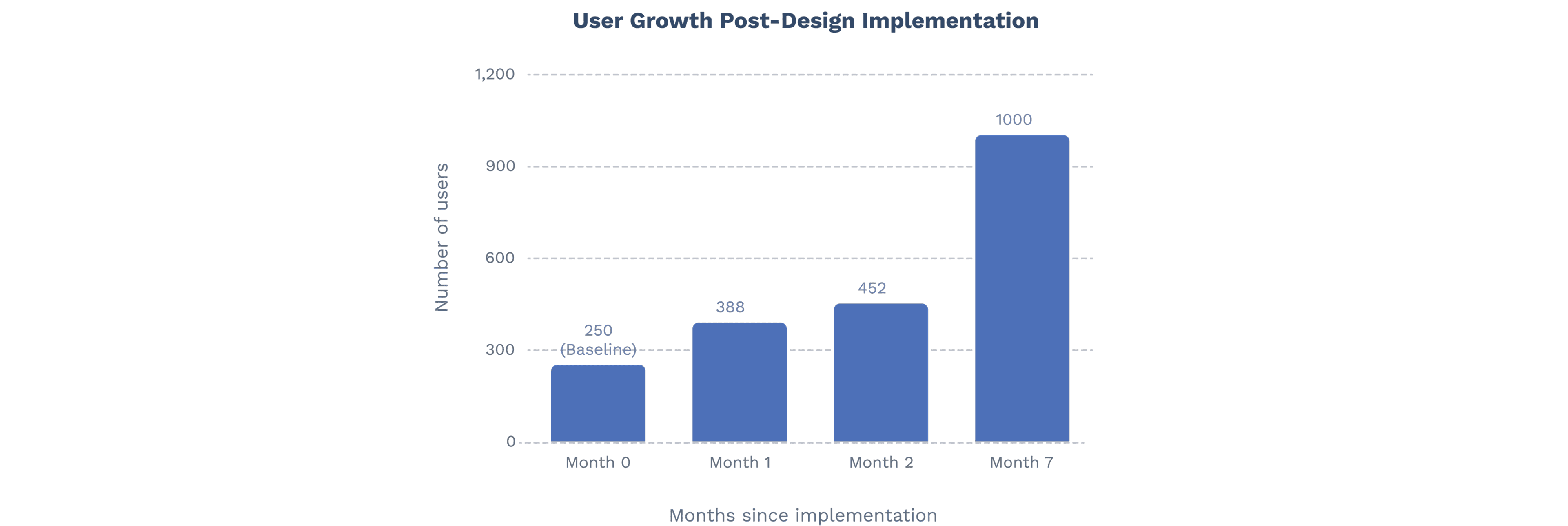
4x growth in active users after 7 months
170% increase in MRR
roles & skills
Founding Designer
Product Strategy
User Research
tool stack
Figma, Figjam
Maze
deliverables
Hi-fidelity prototype
Design System
Quality Assurance
collaborators
CEO
CTO
Solution
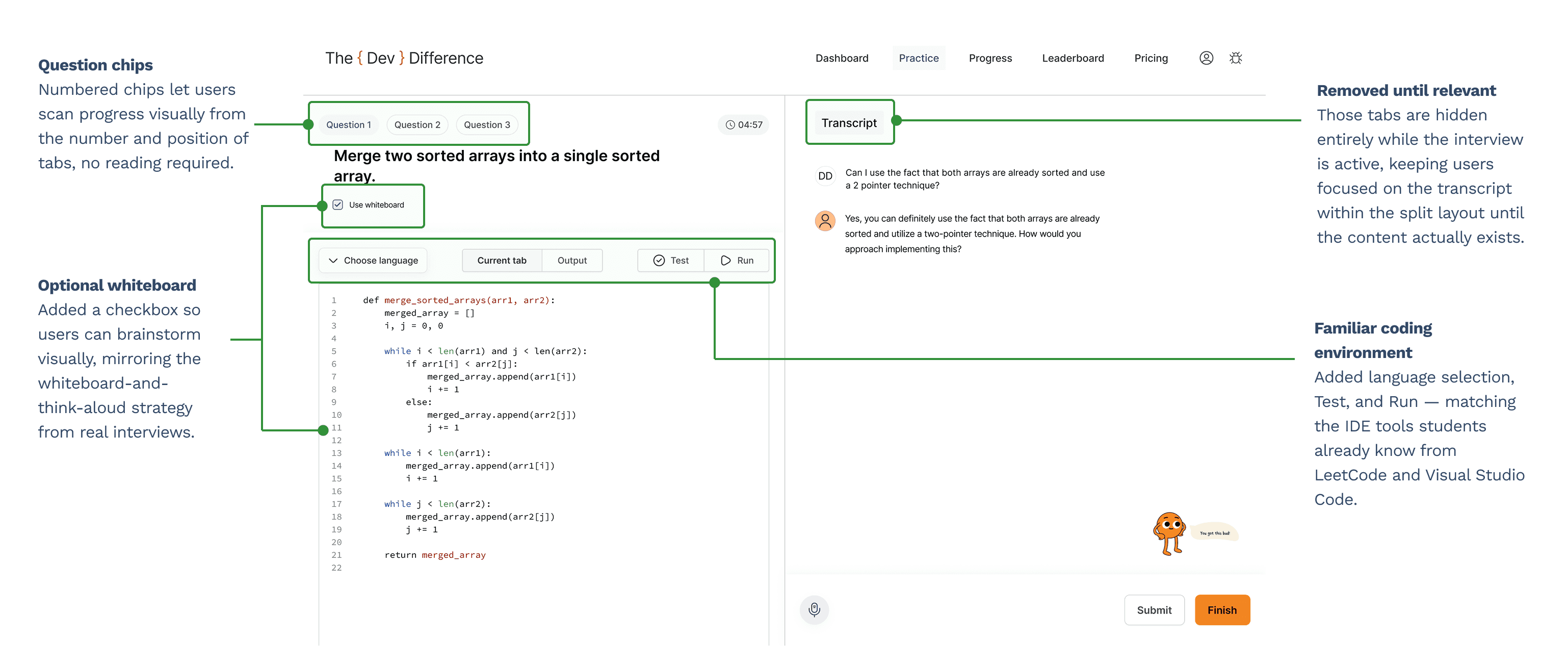
To increase user comfort and confidence during mock interview sessions, I designed a split-screen structured interview layout — surfacing the mock interviewer's live feedback and transcript alongside an integrated development environment (IDE) — giving users a dedicated space to think through and code their solutions in real time. I also built an atomic design system to streamline developer handoff and cross-functional collaboration, reducing wireframe build time by 50%.


Background
Interview Anxiety & Lack of Confidence
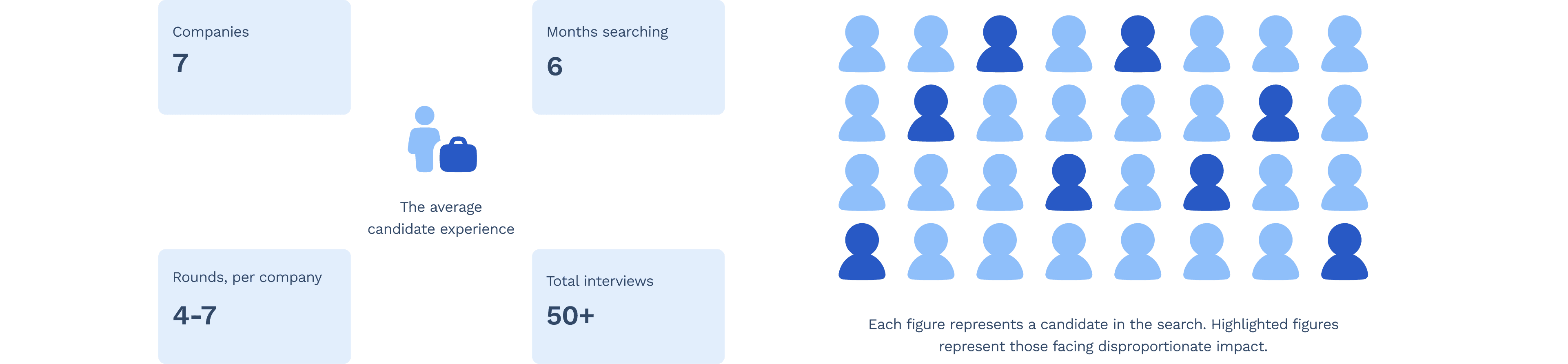
Breaking into tech is tough, especially for underrepresented candidates facing structural barriers. The numbers speak for themselves, as candidates often experience:
🔹Interviews with 7 companies on average
🔹4-7 rounds interviewing, per company
🔹Navigating the job search for an average of 6 months before receiving an offer
Therefore, candidates could experience upwards of 50 interviews for different companies over their job search process. For many, the process is exhausting. A performance poorly in an interview can impact earnings for years, disproportionately affecting candidates who identify as Women, Black, Latinx, Native, Pacific Islander, and LGBTQ+.
The Problem We're Tackling
From preliminary research, we found that students preparing for technical interviews are forced to stitch together separate tools for coding practice and communication coaching, leaving them under-prepared for interviews that actually test both at once.
On top of developing their proof of concept, The Dev Difference brought me in to help achieve two of their goals: increase conversion and improve user retention.
🔹Business Goal 1: Increase conversion by turning early interest from outreach and marketing into activated, returning users.
🔹Business Goal 2: Improve retention through UX/UI since user behavior pointed to friction in the experience, not quality of the content, as the drop-off point.
Constraints & Opportunities

My Process
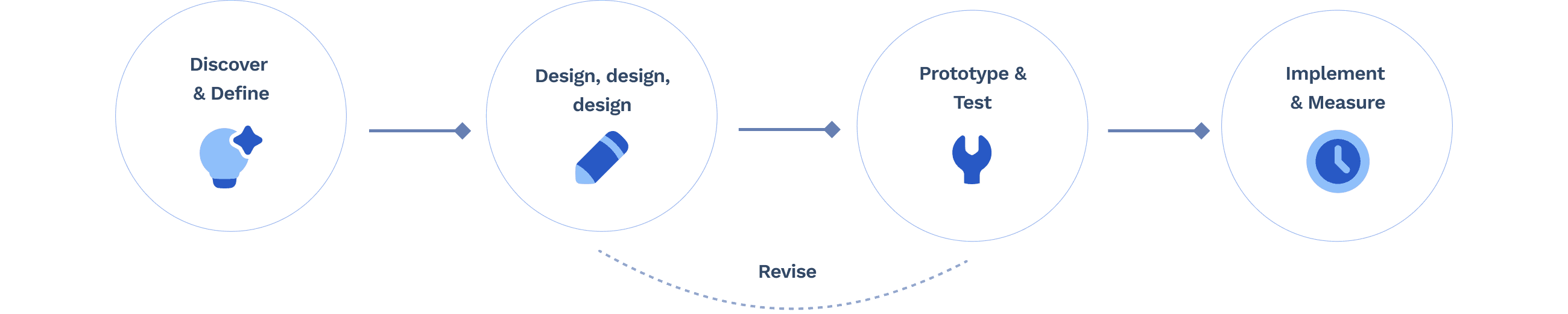
As the founding — and only — product designer on The Dev Difference, I ran a standard end-to-end UX process across discovery, research, design, and handoff.
Given the two-month runway, this wasn't an iterative loop between stages. I followed a deliberately linear path with just enough validation built in at each step to move forward with confidence rather than certainty.
Findings
Quantitative Usability Testing (Maze)
To complement the qualitative interviews, I ran unmoderated quantitative testing on Maze using the current proof of concept created by the founders, tracking two core flows at scale.
Task 1: Sign up and intake form
🔹Could users complete the intake form smoothly?
🔹This flow was testing whether onboarding held up unmoderated, without someone there to clarify confusion in the moment.
Task 2: Complete a practice interview
🔹Could users independently complete a full mock interview session?
🔹We wanted to assess whether the mock interview flow was intuitive, at a sample size large enough to surface friction points invisible when directly helping users with interview tool.
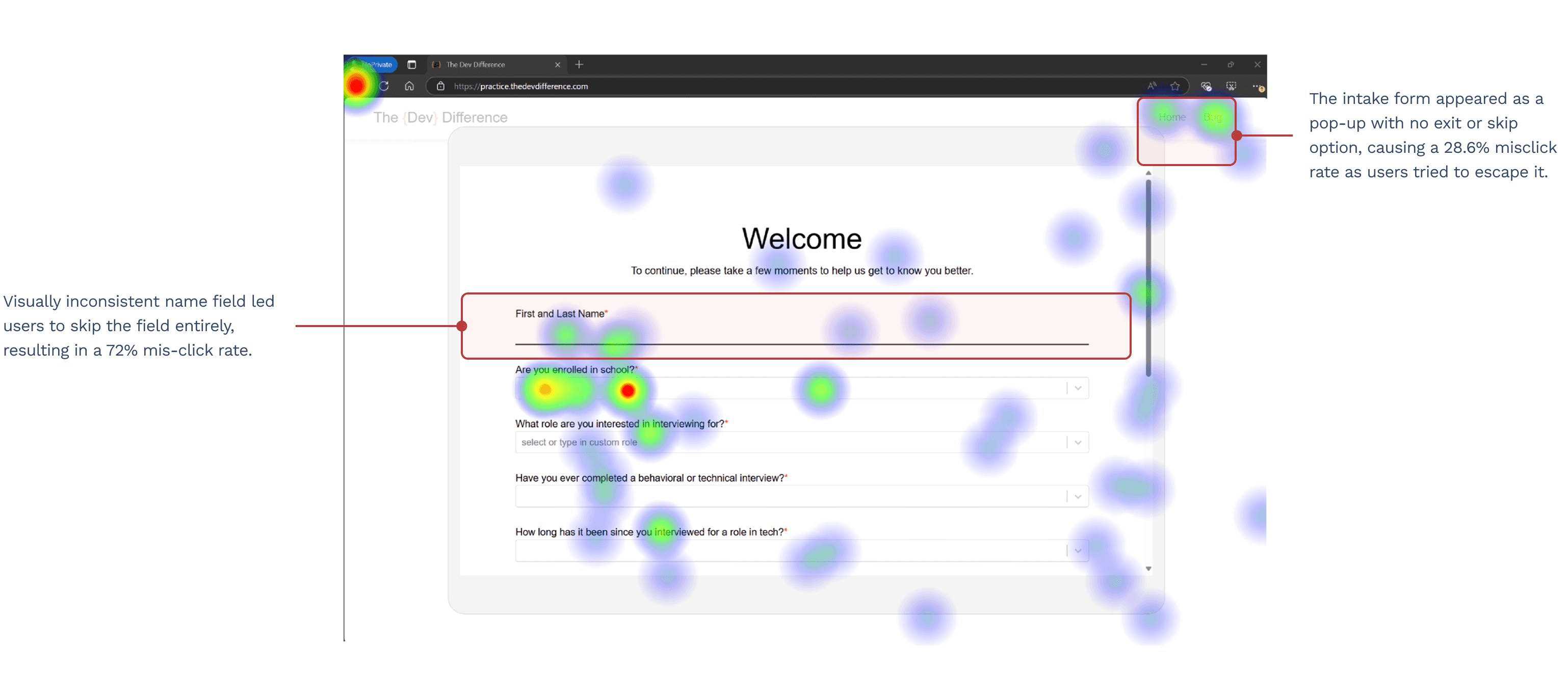
Intake Form
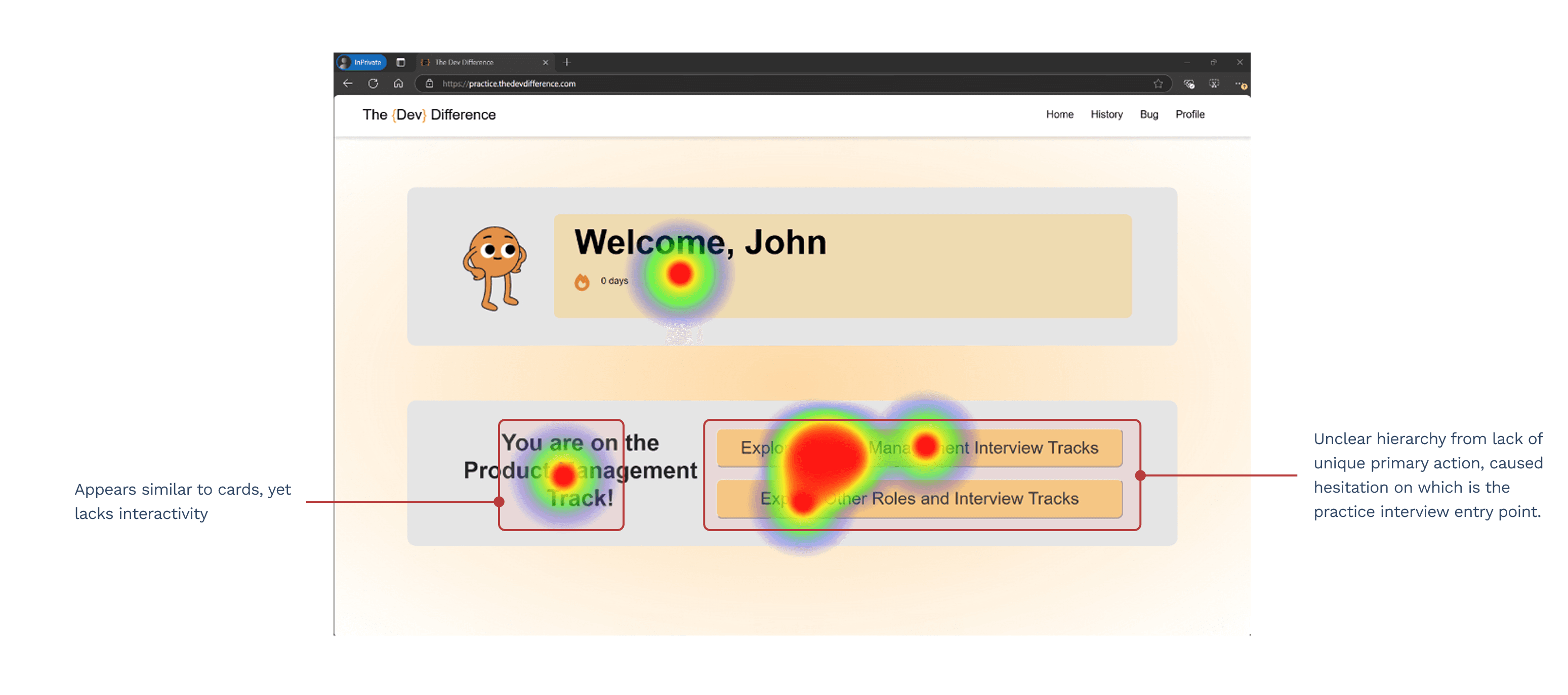
Dashboard
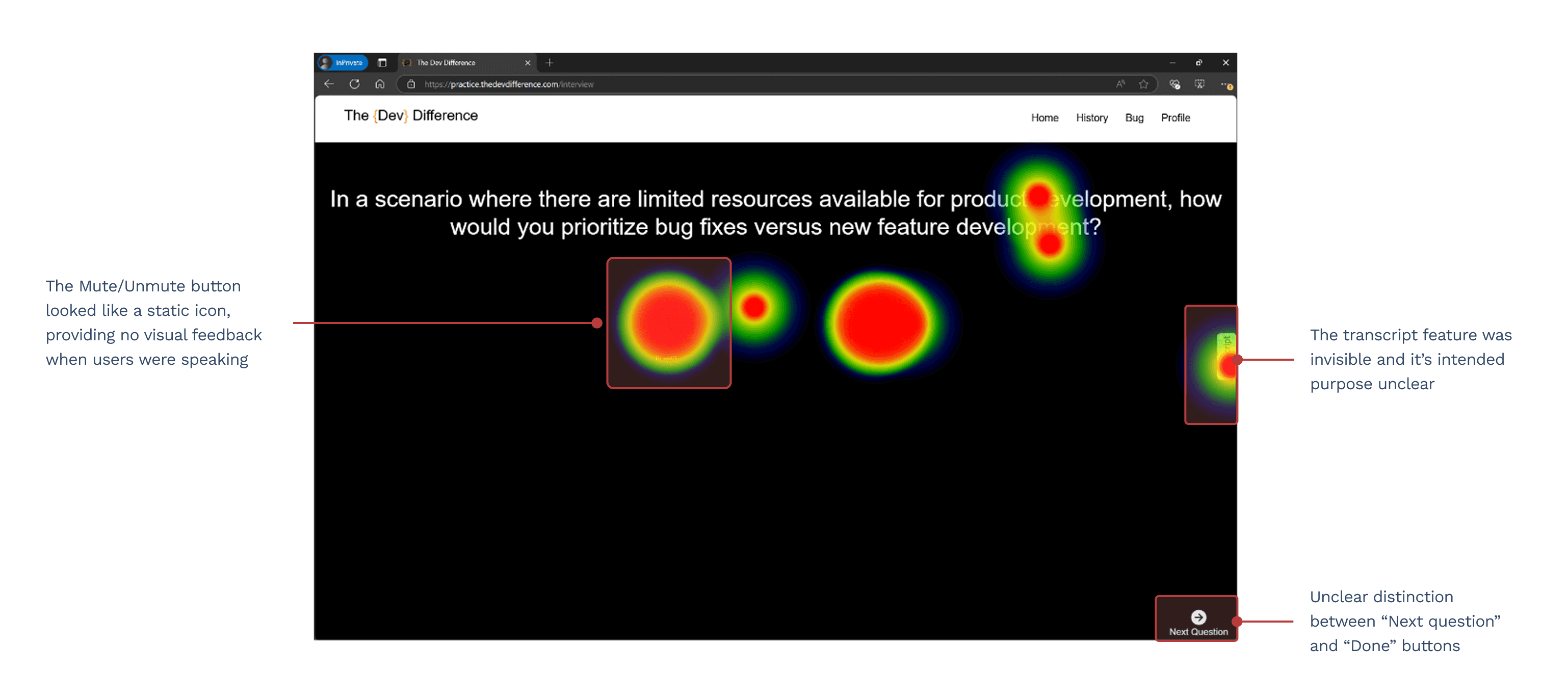
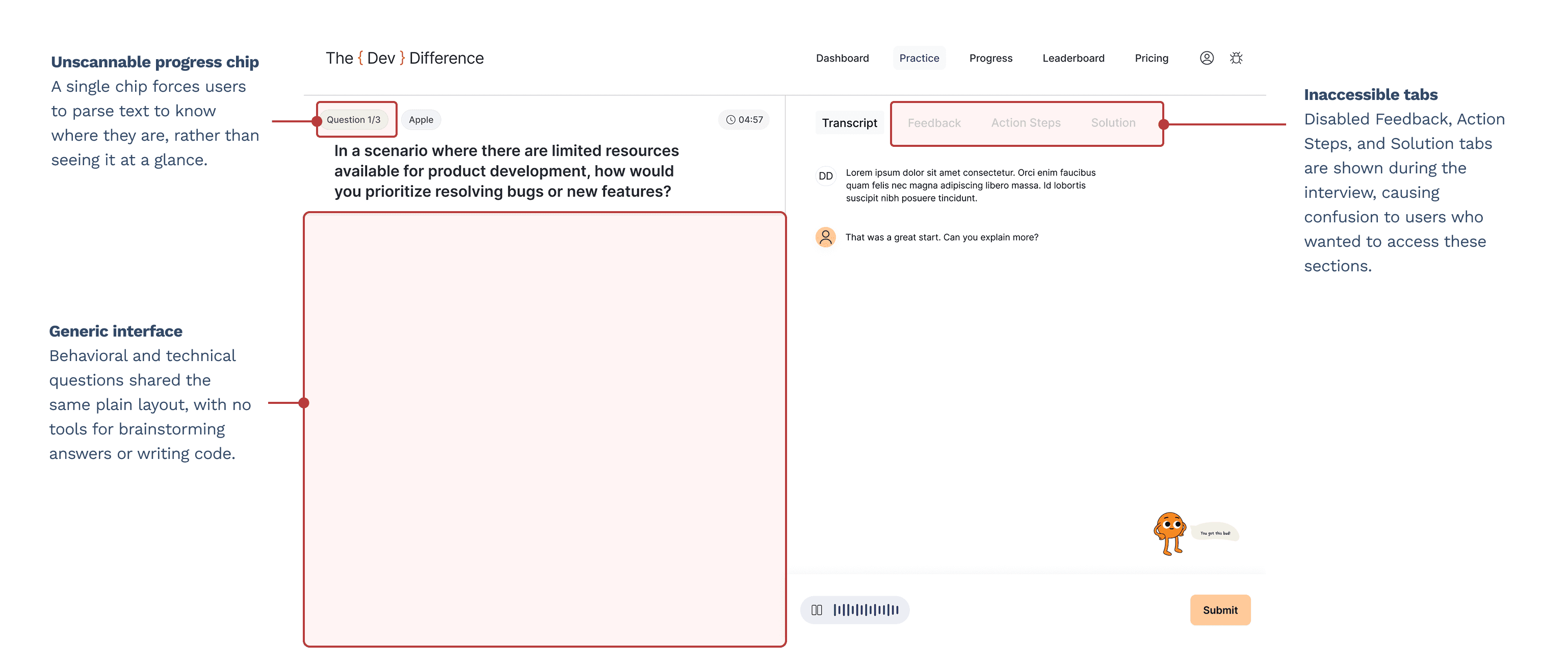
Practice Interview Tool
Findings: Completion Rates Undeterred
Despite the mis-click friction, task completion remained high, as the practice interview flow had a 100% completion rate. And while 79% of users expressed interest in reusing the tool for future interview prep, 63% also expressed dissatisfaction with the tool's usability. This highlighted the gap between wanting to return and actually having an easy time doing so.
This led me to think that the friction points weren't reasons to rethink the flow, but were the specific, addressable gaps standing between users who already wanted this tool and one that made it easy to keep coming back to.
Qualitative Testing
The Maze data told me how often specific friction points occurred at scale, but not why — to understand what was actually happening in users' heads at those moments, I followed up with moderated interviews and observed usability testing. I conducted semi-structured user interviews with participants in undergraduate and masters programs, as well as jobseekers hoping to pivot into tech.
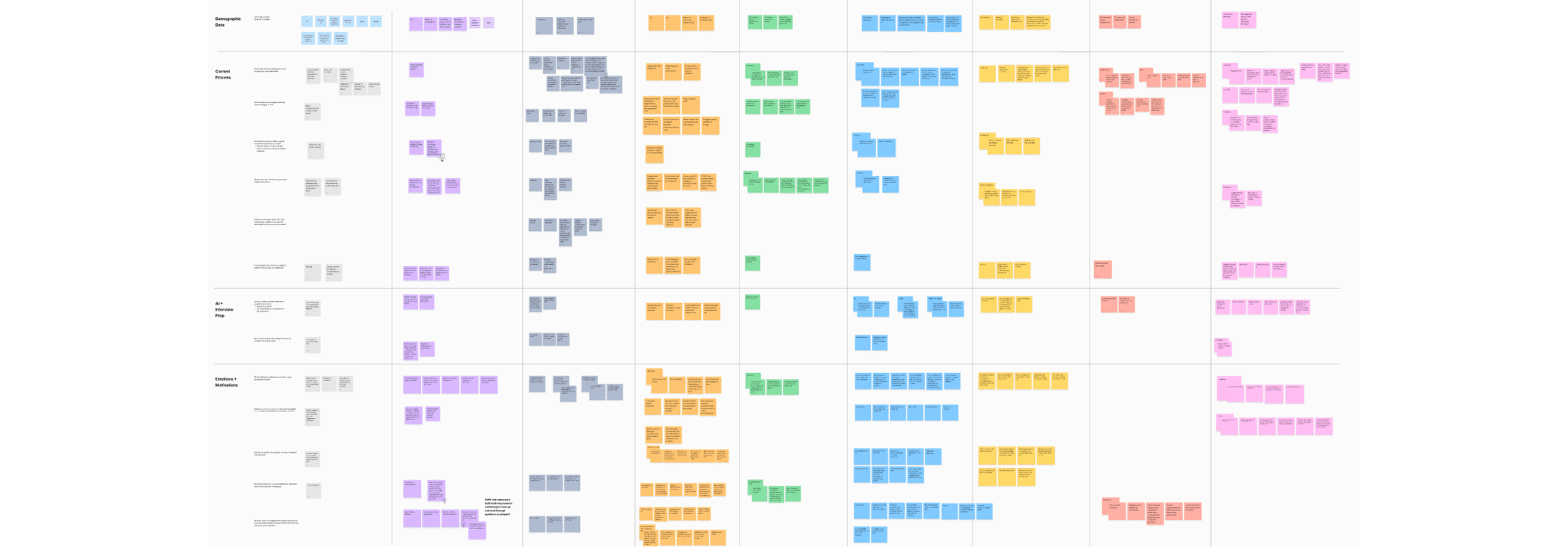
From the interviews, I did an Affinity Mapping exercise to synthesize themes that came up about jobseeker’s motivations for interview prep, how they typically prepare for interviews, and how well The Dev Difference could fit into their current process.
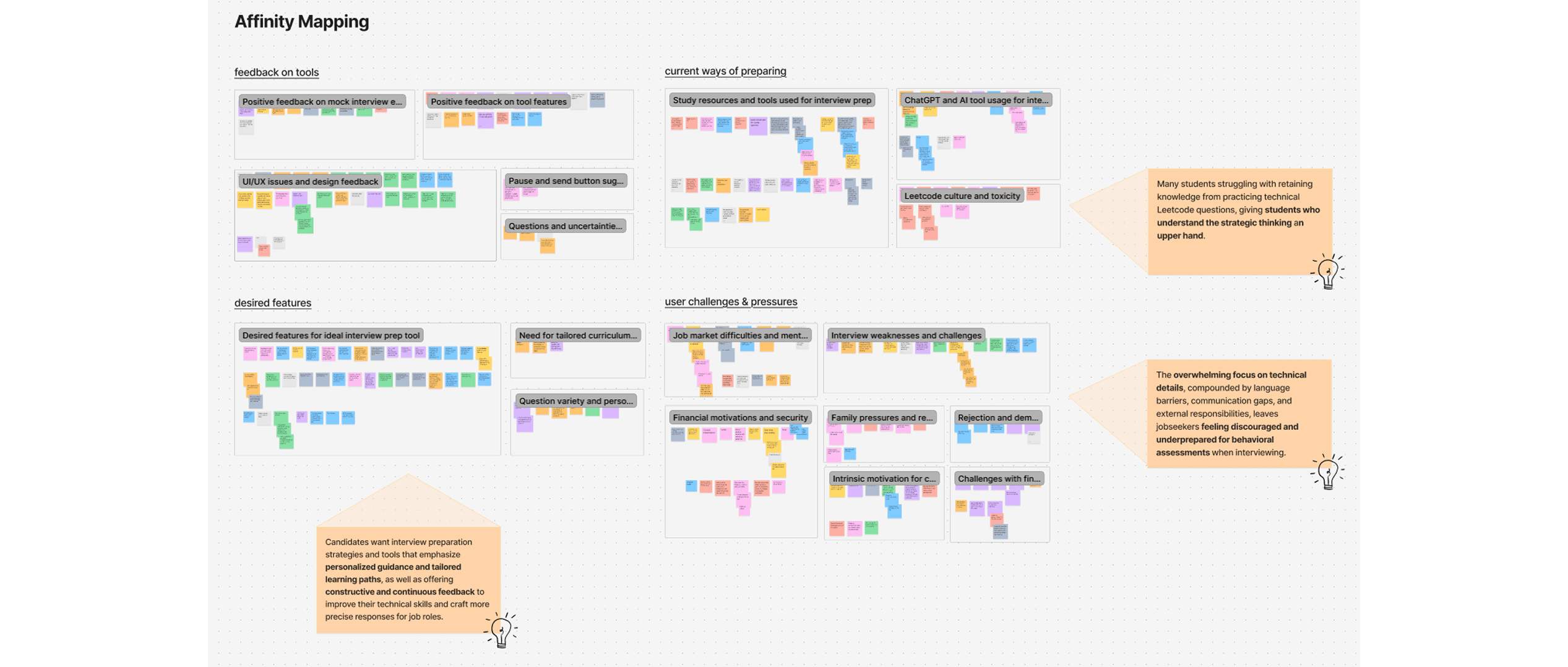
Through the interviews, I narrows down the key pain points affected our jobseekers interested in our tool was due to the:
🔹Ongoing stress & self-doubt from lacking a structured approach and curriculum to follow, especially for roles assessing both technical and behavioral skills
🔹Inability to take advantage of the tool's full capabilities because of undiscoverable core features, such as creating custom questions and progress tracking
Before jumping into ideation, I mapped out some design specifications to shape this product based on the key insights and pain points I observed from users.

My Approach
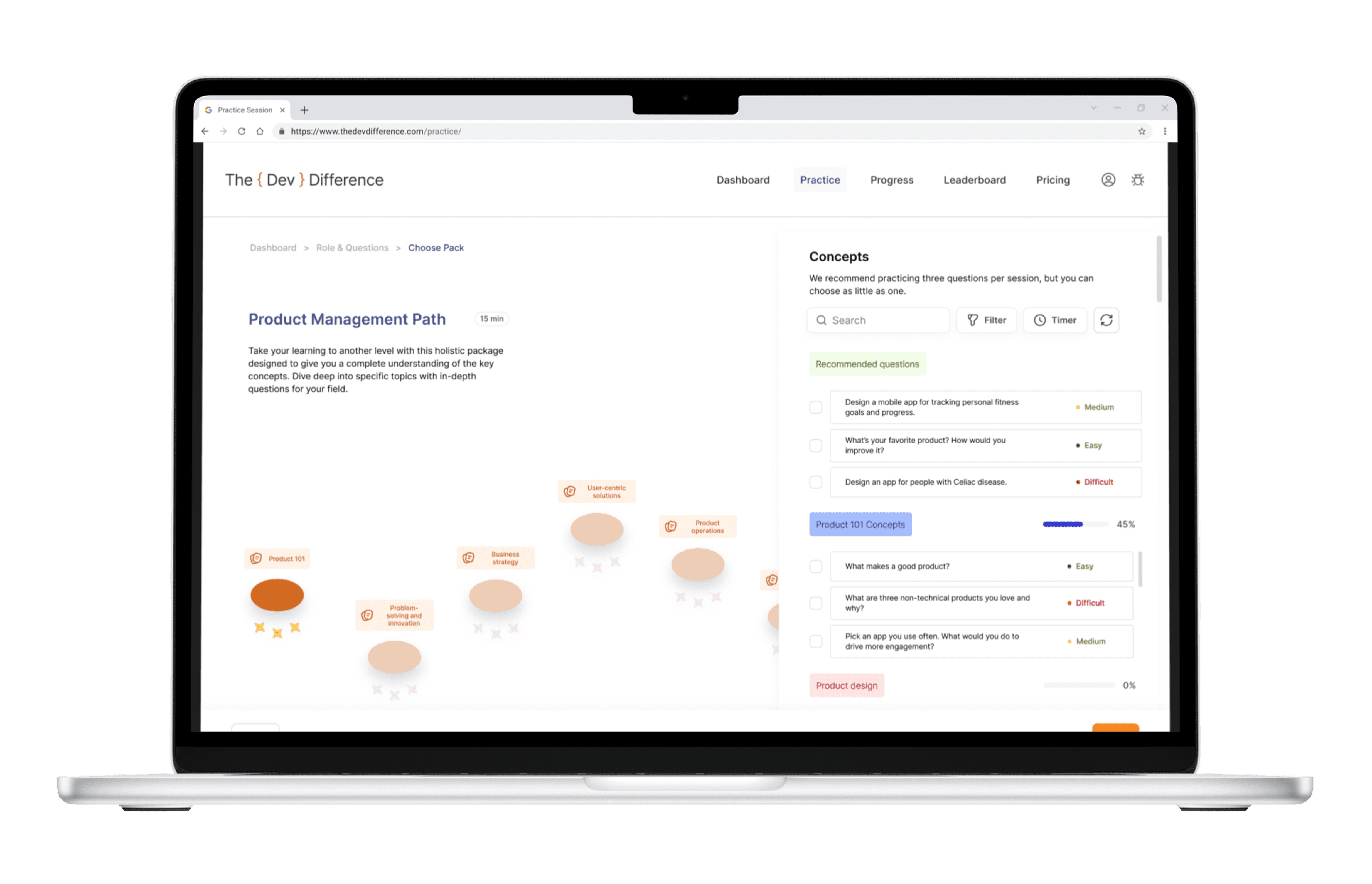
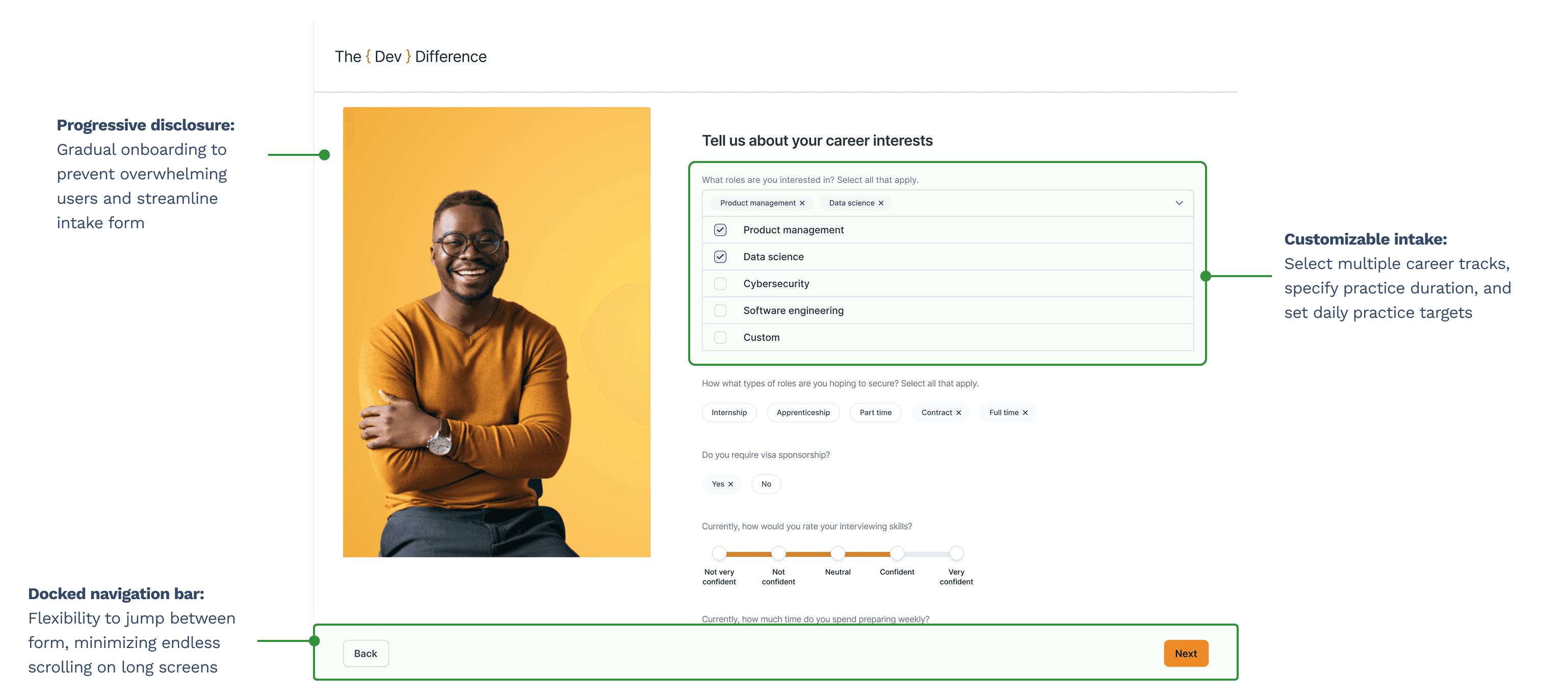
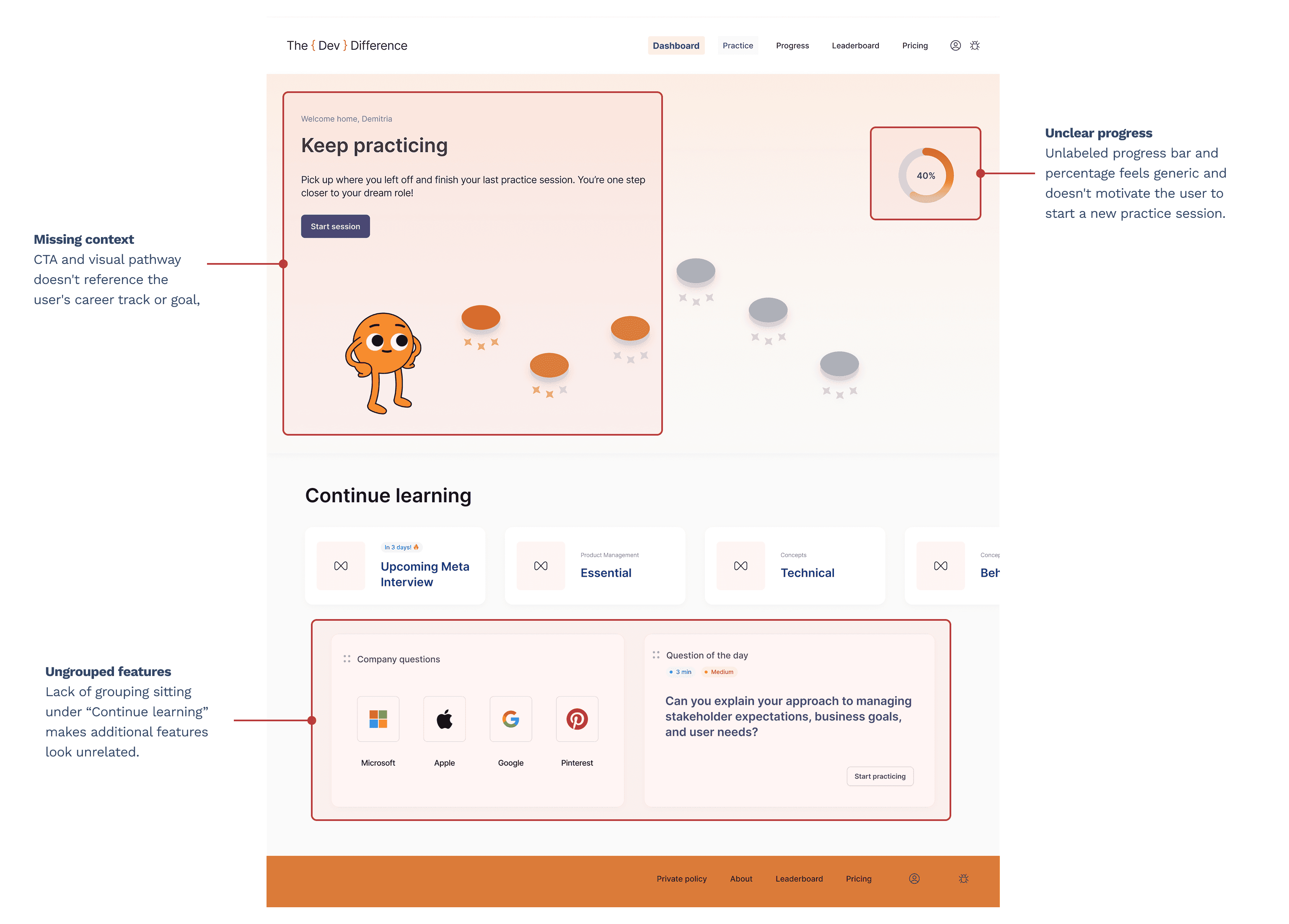
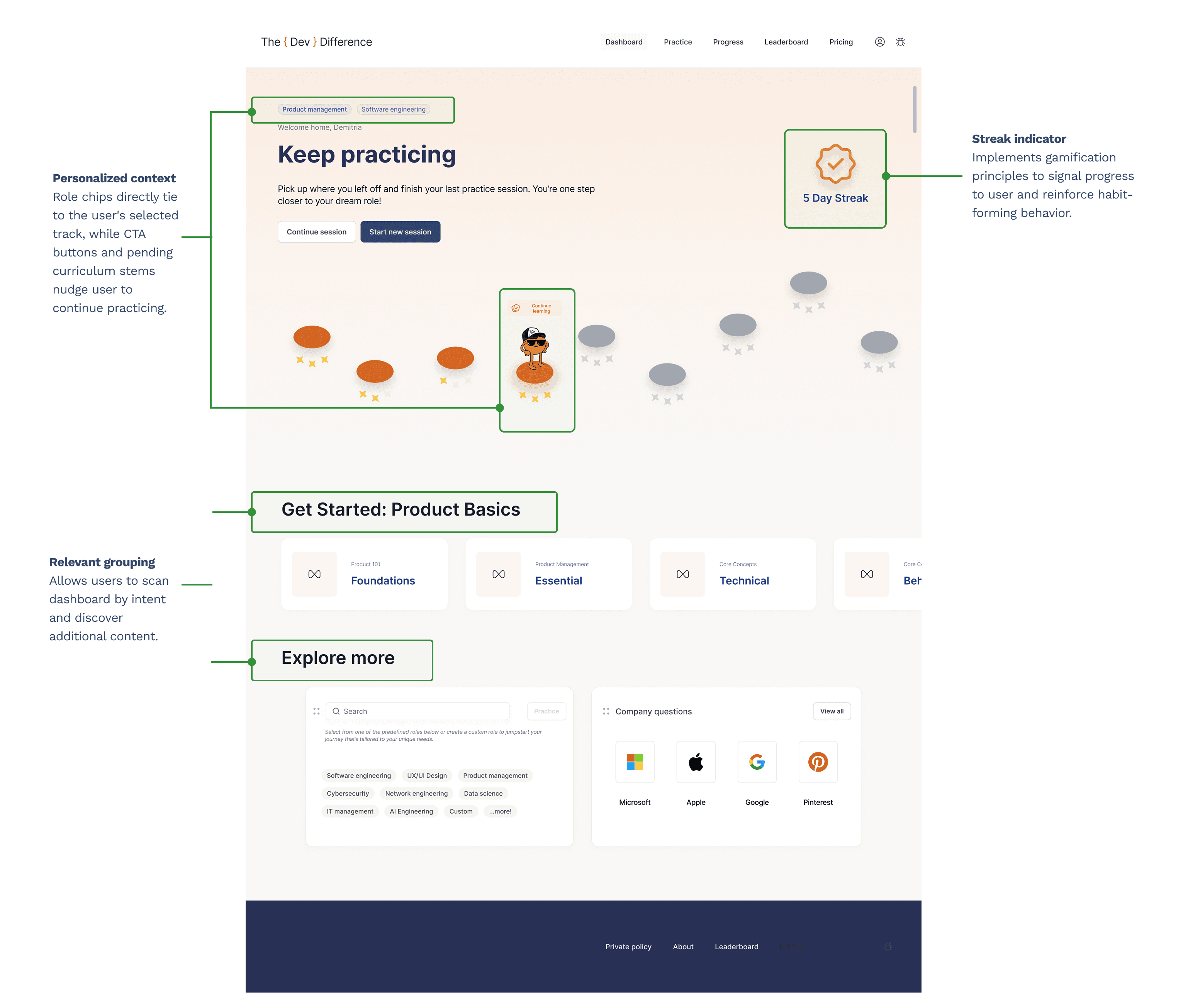
I designed the MVP from zero-to-one, implementing a new intake form that caters to users diverse interests and career goals, a gamified dashboard to increase user-re engagement, and an interview practice tool with a split screen paneling.
Intake Form: Adding Personalization
Dashboard: Reducing Friction to Re-engage and Discover Features
Interview Tool: Sharpening User Focus and Technical Prep
What was the impact?
The startup brought me in to revamp their UX/UI as they continued hosting sales calls and presenting at pitch competitions. Post-launch, the tool saw strong user traction and revenue growth, and my designs played a pivotal role in helping the startup land its first enterprise client.