2025

Pilot

Pilot

client

Pilot an all-in-one platform that streamlines complex hospitality operations by offering data-driven insights to elevate premium guest experiences.

project brief

As Senior Product Designer & Product Manager, I owned core UX/UI flows and led strategy by partnering with engineering, operations, and leadership to help resorts, nightlife venues, and fashion clients manage event ticketing, seating, and communication.

roles & skills

AI prototyping

UX/UI Design

Product management

tool stack

Claude, Figma Make

Figma, Figjam, Variables

Confluence, Jira

deliverables

Event creation flow

White label design system

Client dashboard & portal

collaborators

Operations & Sales

Director of Technology

External clients

Solution

Booking & Management Ecosystem

Booking & Management Ecosystem

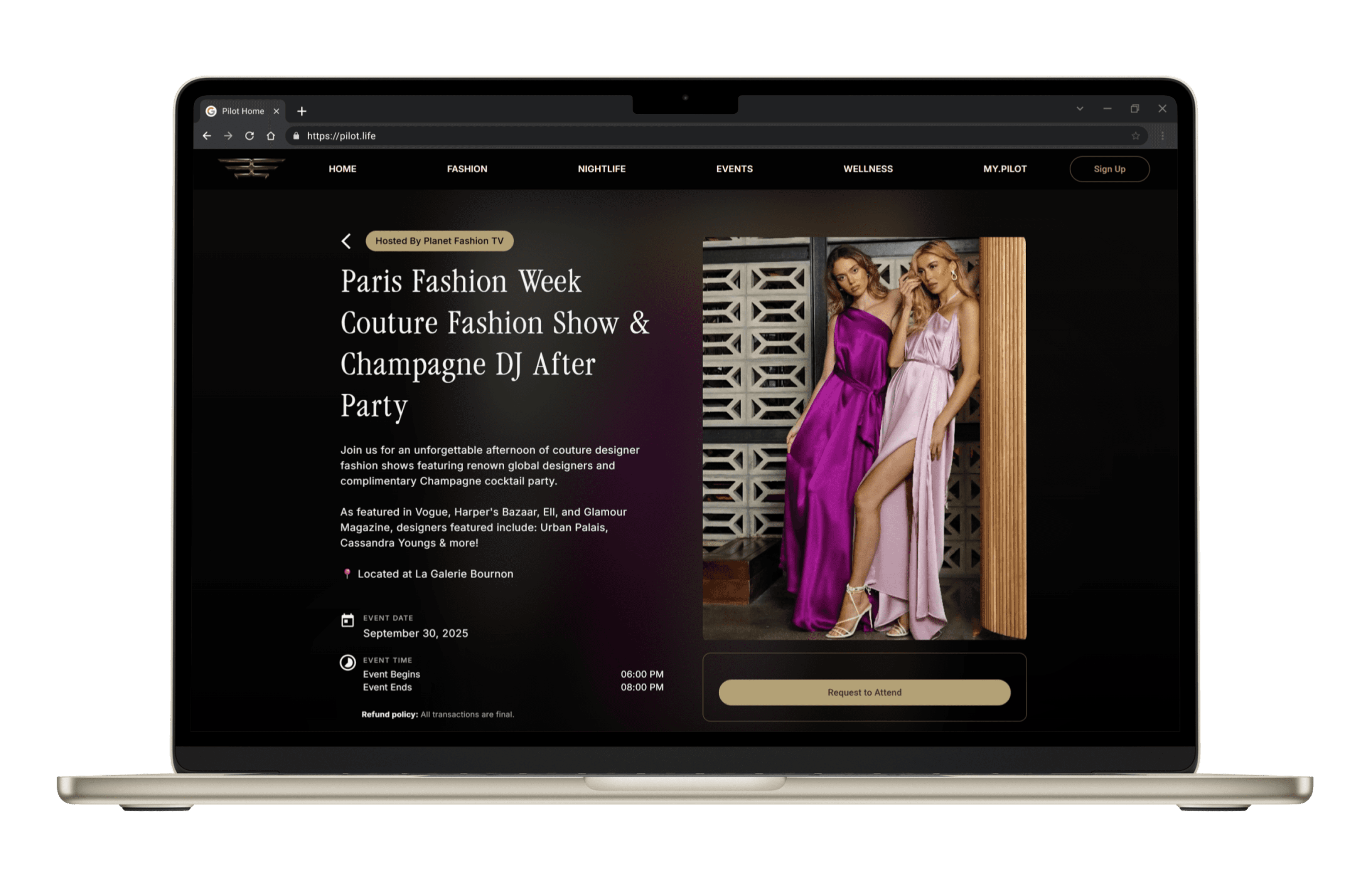
With both a customer-facing front-end and robust event management backend for organizations, Pilot consolidates table booking, ticketing, customer data, operations, and communication into a single, unified system. Here's how it works:

  • Event Execution Hub: Guest lists, RSVPs, check-in, and attendee reporting all in one place.

  • Unified Booking & Seating: End-to-end table booking, ticketing, and assigned seating for venues and fashion shows.

  • Operational Efficiency: Tools to create venue-specific floor plans and manage seating dynamically during high-volume events.

  • Customer Revenue Management: Centralized profiles capturing guest spend, preferences, and contact information

  • White-Label Portals: A customizable, white-label solution aligned with client’s brand guidelines.

  • Multi-Organization Oversight: Quick, data-informed insights across multiple brands or venues from a single view.

Background

Despite the high cost, guests were having cheap experiences

For premium events, guests expect an experience that feels frictionless, personal, and worth their time. Whether they’re booking a table for a big night out or attending seasonal fashion shows and luxury sporting events, they want clear communication, smooth check-in, and a sense of intentional care. Instead, many are met with slow responses from the organizer, confusing instructions, or even seat assignments scribbled on index cards.

These small moments add up, and for high-net-worth guests accustomed to an elevated service, operational missteps quickly eroded trust and diminished the experience.

Premium events were powered by fragile operations

Venues and event teams feel the strain just as intensely. They’re juggling large volumes of booking, ticketing, and VIP requests while relying on manual workflows that are fragile and time-consuming. Errors compound under pressure, leaving them with mismatched guest lists across duplicative spreadsheets, inconsistent customer identification, and no reliable way to track top spenders or their preferences.

Without a unified system, teams are forced to bounce between disconnected tools, making it difficult to see what’s happening in real time, anticipate demand, or communicate effectively. This results in organizer’s producing slower service, handling frustrated guests, and losing revenue opportunities.

Findings

Running events with disconnected tools

Existing solutions don’t help much. Reservation services like Posh, SevenRooms, Tablelist, and Zkipster take a hefty percentage of table revenue and still deliver outdated, clunky interfaces that staff struggle to learn. Others offer only partial solutions, such as tools for guests but not venues, or vice versa, leaving organizations to piece together their own workflows across multiple platforms. Without a true end-to-end system, teams are left without technology that matches the pace, complexity, or expectations of modern hospitality and fashion events.

My Approach

Moving between discovery ↔ design

Without revealing confidential or proprietary information, these are the high-level outcomes I supported and achieved in my role working across both design and product. This hybrid role allowed me to ensure end-to-end alignment from product vision → UX design → execution → client delivery, and gave me opportunities to fill in gaps between user insights, design decisions, business priorities, and engineering constraints.

For more details about a specific initiative, please feel free to contact me for a case study walkthrough.

What was the impact?

Streamlining creating events for hosts

Being a solo designer at Pilot means I have autonomy to directly shape the user experience of the flows that our customers interact with regularly. This ownership allows me to make thoughtful, industry-specific design decisions and focus on designing intuitive, high-quality, and easy-to-use software that exceeds the expectations of our clients when they create and publish an event by:


Scaling the team's efficiency for client white-labels

As both designer and product manager, I also influence how smoothly the engineering team at Pilot moves and is able to ship. Beyond UI, I drive clarity around requirements, scope, and priorities, helping streamline internal design–development–delivery processes, particularly when building unique white label environments by creating fully-branded mockups for Sales calls with prospective clients. These mockups helped close deals with projected 6-figure annual revenue.

🔹Defining a scalable design-token system using Figma Variables to quickly tailor white-labels to a client's branding guidelines

🔹Creating fully-branded mockups for Sales calls with prospective clients, helping close two deals with projected 6-figure annual revenue


After spinning up the first two white labels, I recognized that as Pilot continued to grow and build additional white-labels, designing and supporting engineering with QA testing the environments once they were built on the front-end was a key area where efficiency could be introduced.

Looking ahead, I began researching Figma capabilities that could support the anticipated need to spin up back-to-back white labels in alignment with each brand’s guidelines, while also stress-testing the UI on the front end after implementation. From there, I defined a scalable design token system using Modes within Figma Variables. This system created a reusable skeleton that allowed me to quickly tailor white labels to client branding requirements. It also enabled me to create a shared reference for developers by clearly documenting the usage and application of color variables, as well as identifying opportunities to streamline them over time.

By establishing a system designed to improve both current workflows and future design system enhancements, I was able to significantly speed up design and engineering collaboration with the following results: